

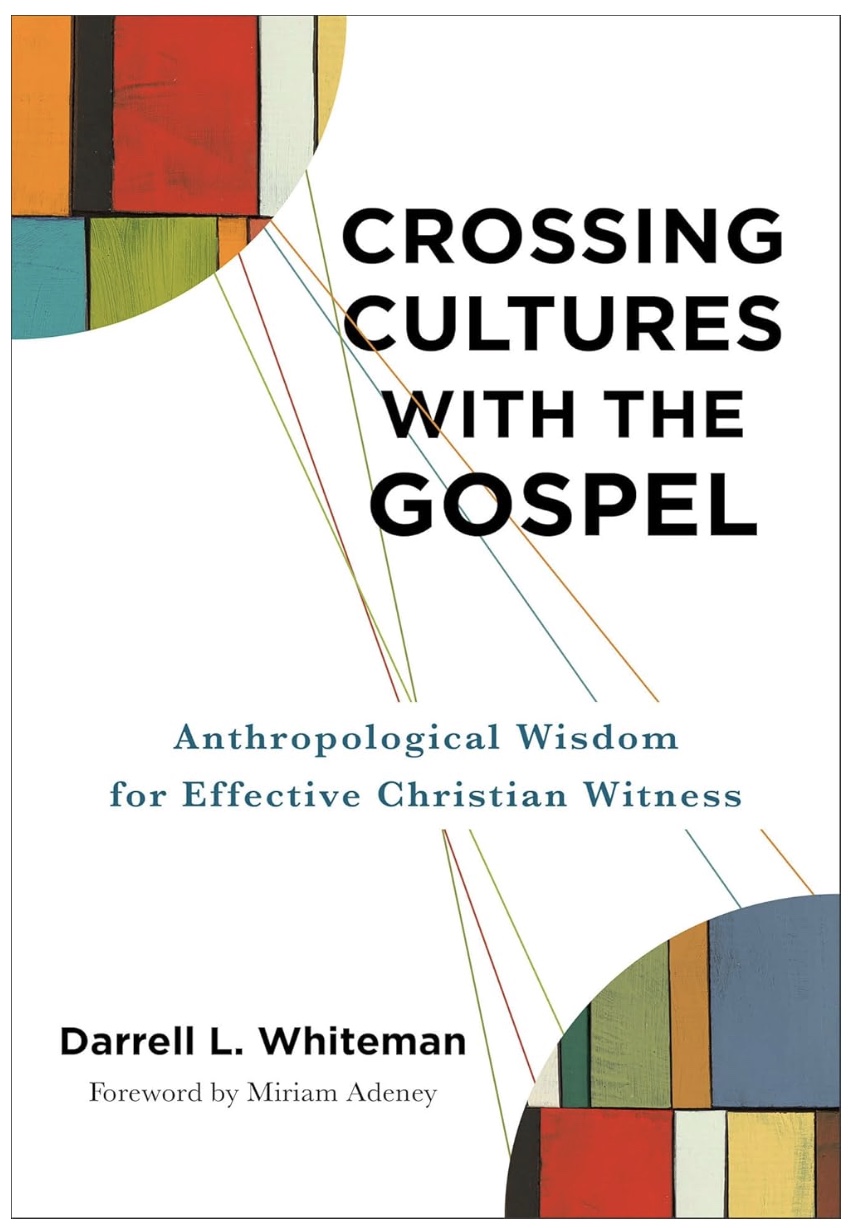
02 Mar 2026: Crossing Cultures with the Gospel: Anthropological Wisdom for Effective Christian Witness – Book Review
Crossing Cultures with the Gospel: Anthropological Wisdom for Effective Christian Witness
Darrell Whiteman
Grand Rapids, MI: Baker Academic, 2024. 225 pp. $23.26
Reviewed by Cliff Jenkins, Associate Director, Doctor of Ministry and Associate Professor of Leadership Formation, Gateway Seminary
Crossing Cultures with the Gospel: Anthropological Wisdom for Effective Christian Witness is a timely book written by Darrell Whiteman for missionaries regarding strategic cultural engagement. Whiteman is a missiological anthropologist with many years of experience in training individuals for cross-cultural ministry. He has served as a missionary in Central Africa, Papua New Guinea, and the Solomon Islands and has taught for over twenty years at Asbury Theological Seminary. Whiteman is also the founder and director of Global Development, an organization focused on equipping leaders to communicate the gospel across cultures.
Written with the missionary in mind, he states that the purpose of this book is to challenge the reader’s ethnocentrism and to encourage them to transform their lifestyle to foster deeper engagement with the culture in which they serve. He writes, “Naively, we think the way we see the world is the way the world really is for everyone. We therefore spend too much of our energy trying to convince others to see the world the way we do.”[1] Whiteman writes to encourage the reader to share the gospel so that it is accepted without also having to accept the missionary’s culture.
The book is organized into five official parts. The first part unpacks the concept of culture by examining the various ways leading anthropologists define it, culminating in Whiteman’s own definition. He then alerts the reader to the missiological dangers of reifying and totalizing culture. This section also outlines the functions of culture and its role in sharing the gospel.
The second part introduces incarnational ministry, which is the crux of Whiteman’s argument. In this area, he uses the incarnation of Jesus as a strategic model for sharing the gospel across cultures. He cites writings by Darrell Guder and Frost and Hirsch’s Shaping of Things to Come: Innovation and Mission for the 21st Century Church as support for this model. His argument is that Jesus’s incarnation is a prescription for cross-cultural gospel sharing. He writes, “the incarnation as a model for cross-cultural ministry means we must be willing to work within whatever condition a culture is in, regardless of how unsophisticated or corrupt it may appear to be.”[2] Part three addresses common communication problems involving worldview, identity, language, and the perception of reality. Whiteman builds on his incarnational communication model by providing a worldview metaphor that differentiates behavior, religion, and worldview. He posits that the gospel must change a person’s worldview, writing, “conversion to following
Jesus is more about changing the unseen dimensions of who we are—our values, our beliefs, and our worldview- than changing our behavior.”[3]
In the final two parts, Whiteman tackles practical cultural challenges facing missionaries. He addresses understanding, overcoming, and embracing culture shock and then follows that section with strategies for becoming an effective communicator. These sections can be beneficial for new and seasoned missionaries alike. For example, he views culture shock as an inevitable stage of a missionary’s experience and encourages them to embrace it. This is a welcome shift away from attempts to minimize or avoid the shock of transitioning between cultures.
Crossing Cultures with the Gospel promotes a practical, relational approach for cross-cultural missional engagement. Whiteman’s ideas can be condensed into four essential strategies for faithful cultural engagement: eliminating ethnocentrism, living out an incarnational missional model, understanding the significance of worldview, and recognizing the cultural baggage that accompanies serving as a cross-cultural missionary.
Surprisingly, Whiteman spends a minimal amount of time attempting to convince the reader of their ethnocentrism and assumes the reader’s agreement. Instead, focusing on what he calls the necessary two “conversions” of a missionary, which is the unofficial first part of the book. He uses the biblical example in Acts chapter ten with the Apostle Peter and views God’s engagement with Peter as a second conversion that cleanses him of his ethnocentrism. For the missionary, their first conversion is to faith in Jesus Christ, while the second one is a conversion to remove their ethnocentrism.
Whiteman leans on his anthropological training and experience to train missionaries on the importance of relationships in evangelism. He writes, “Effective cross-cultural ministry and discipleship require one to be able to form, develop, and maintain personal relationships”.[4] He seems to view culture as a vital path towards understanding others and ultimately building relationships for the purpose of rich gospel conversations.
He next unpacks his seven-part model on the incarnational communication of the gospel. This is one of the most enlightening parts of the book, where his anthropological knowledge and missional experience converge to provide an intentional, strategic model for cross-cultural gospel communication. This model requires the missionary to develop a meaningful understanding not only of the culture of those to whom they are communicating the gospel, but also of their own culture.
The last strategy deals with understanding cultural baggage, which he defines as “the behaviors, material things, attitudes, values, and beliefs we take with us unknowingly into another culture.”[5] Identifying this “baggage” enables missionaries to become better cross-cultural gospel communicators.
While practically refreshing, this book is not without its theological concerns. Whiteman pushes theological boundaries into uncomfortable territory when he recounts several personal missional experiences. In one instance, a person was willing to accept Jesus as their Savior without denouncing their previous religion. The person responded, “I love the Buddha, but I love Jesus so much more.”[6] Arguably, Whiteman’s explication of his theological conviction would have been beneficial.
In chapter four, he admits that theologians may disagree with his use of Jesus’s incarnation as a strategic model for ministry. This is especially true, since Whiteman also argues, “the incarnation demonstrates that God is willing to be present in any culture in every period of human history.”[7] Once again, he does not fully explicate his theological position.
Potential disagreements aside, missionaries, pastors, second-year seminary students, and beyond can benefit from reading Crossing Cultures with the Gospel. I have assigned this book to doctoral students, and they have found it very helpful for understanding the cultures of their ministry contexts.
Assuming that the readers of this book have already experienced their first conversion, which is faith in Jesus, Whiteman’s arguments in this book can prove to be extremely helpful. Confronting ethnocentrism and better understanding various cultures offer new strategies to help individuals make that second “conversion” toward living lives effectively, crossing cultures with the gospel.
[1] Darrell Whiteman, Crossing Cultures with the Gospel: Anthropological Wisdom for Effective Christian Witness (Grand Rapids: Baker Academic, 2024), 8.
[2] Whiteman, Crossing Cultures, 62.
[3] Whiteman, Crossing Cultures, 97.
[4] Whiteman, Crossing Cultures, 14.
[5] Whiteman, Crossing Cultures, 201.
[6] Whiteman, Crossing Cultures, 43.
[7] Whiteman, Crossing Cultures, 62.