
02 Mar 2026: Generative AI and Libraries: Claiming Our Place in the Center of a Shared Future – Book Review
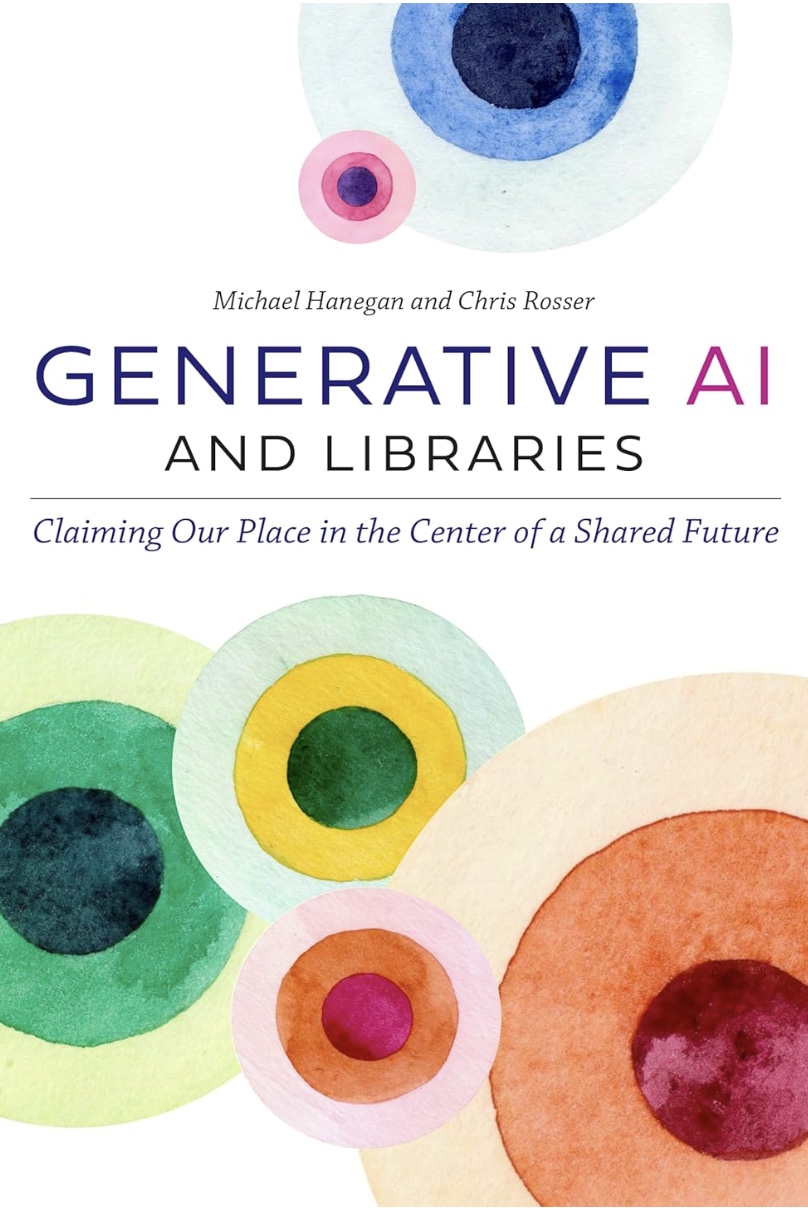
Generative AI and Libraries: Claiming Our Place in the Center of a Shared Future
Michael Hanegan and Chris Rosser.
ALA Editions Core, 2025. 144 pp. $54.99
Reviewed by Garrett Ho, Associate Director of the Doctor of Ministry Program and Associate Professor of Leadership Formation, Gateway Seminary
Why review a book written primarily for librarians in a ministry journal? While Michael Hanegan and Chris Rosser entitled their work Generative AI and Libraries, the volume models faithful cultural engagement, providing an accessible introduction to an emerging field. Although they direct their concrete applications to library sciences, the underlying concepts speak to theological education in general and may be thoughtfully extended to Doctor of Ministry education in particular. This broader relevance is reflected in the authors’ recent service as instructors for two microcredentials co-sponsored by ATS, Atla, and the In Trust Center for Theological Schools. These microcredentials, Generative AI in Theological Education and Leading AI in Theological Education, are not currently available, but with this book now in print, much of their content is accessible in published form.
Hanegan and Rosser organize their book into three parts. Part I, “Foundations of AI in Libraries,” introduces the authors, their purposes, their assumptions, and their approach to the volume. Part II, “Strategic Implementation of AI in Libraries,” offers guidance and a framework for the AI integration process. Finally, Part III, “The Future of Libraries in the Age of Intelligence,” turns to the implications of AI for libraries’ ongoing mission. The libraries’ focus is unmistakable, yet the emphasis on foundations rather than specific tools or implementations means the book effectively functions as an introductory text on AI in theological education as well. Make no mistake, Hanegan and Rosser are familiar with the AI application landscape. They made use of ChatGPT, Claude, Fathom, Notion, and Perplexity in their writing, to name a few. So, it is with significant restraint and purpose that they deliberately concentrate “on developing robust frameworks… recognizing that specific AI tools and applications will evolve, but fundamental principles will remain essential” (xiii). They later summarize this goal succinctly: “This book offers not a comprehensive manual but an essential grammar, providing foundational concepts, imaginative frames, and practical models” (14). In this review, we highlight Hanegan and Rosser’s creation of an “essential grammar” by reviewing the authors’ key concepts, frames, and models and draw some connections to Doctor of Ministry education.
The authors begin with foundational concepts. They define terms such as large language models, machine learning, natural language processing, generative artificial intelligence, neural networks, and algorithmic systems. They do so with a clear sense of context, supplementing technical descriptions with creative descriptions that make use of simile to translate these concepts into terms that connect with librarians. Their attention to language carries into their treatment of the AI integration process, where they carefully distinguish among “use,” “adoption,” “implementation,” and “integration” of AI. This methodical approach to the topic makes it approachable and transferable across disciplines. A particularly important term for the authors is “metaliteracy.” For Hanegan and Rosser, metaliteracy is essential to understanding and harnessing AI. They return to it in their four-fold framework for AI integration and devote a full chapter to metaliteracy as “a comprehensive model that unites cognitive, metacognitive, behavioral, and affective domains in the service of deeper learning and engagement” (95). Doctor of Ministry educators will recognize this language as they unite these same domains in the service of ministry leader formation.
It is in the realm of imaginative frames that the authors contribute most and occasionally stumble. While the authors are generally meticulous with terminology, they appear to use “concept,” “frame,” and “model” in a fluid manner. For example, when they speak of “these orienting frames” (29), they seem to refer to the “in, of, and for the world” framework, which includes the value of imagination, core values (i.e., transparency, curiosity, rigor, inclusion, and play), and human being. Later, the authors provide seven different frames that make up their AI Literacy Framework (see pages 99-100). Perhaps it is a minor issue to expect consistent, judicious use of terms. However, given their ambition to craft an “essential grammar,” the looseness in these categories requires some notice. A further illustration is their treatment of “collaborative co-intelligence,” a concept by which AI “can extend our creative and analytical capacities” (40) as creativity is applied. The authors contrast this hopeful future with the alternative “technological takeover” that may happen if human beings outsource their thinking, rather than developing a “nuanced partnership where human expertise and artificial intelligence combine to create capabilities greater than either one could achieve independently” (39). Additional frames supplied by the authors can be found within the ACRL Framework for Information Literacy for Higher Education, the four-fold framework for AI integration, the Learning Design Framework, and their own STACKS framework. Doctor of Ministry educators are likely to find these imaginative frames and framework introductions suggestive and adaptable.
The final component of the introductory “grammar” is a set of models. Although the authors sometimes treat “metaliteracy” as a model, two other models receive particular emphasis: UTAUT2 and the Gravitational Model of AI Literacy. Hanegan and Rosser describe the Unified Theory of Acceptance and Use of Technology 2 (UTAUT2) as “the most helpful technology adoption model as it relates to generative AI and libraries” (66). While they do not explain the model thoroughly, they do provide insights drawn from the model. This leads them to identify three failed approaches to AI integration: “no one left behind,” “aim for the middle,” and “the frontier is everything” (67-68). This analysis prepares readers to recognize the value of the Interest and Readiness Matrix the authors propose as a first step toward a nuanced alternative. The Gravitational Model of AI Literacy, in turn, distinguishes between the Core, Ground, and Atmosphere, using a metaphor from nature to describe the layered relationship between durable skills, ethics, and value (core), multiliteracies (ground), and dynamic AI competencies (atmosphere). This perspective resonates strongly with librarians’ self-understanding as cultivators of durable skills, yet it also maps closely onto the skills that Doctor of Ministry educators also nurture: critical thinking and analysis, synthesis and integration of complex ideas, collaboration and teamwork, ethical reasoning and decision-making, metacognition and self-reflection.
In Generative AI and Libraries, frames may be presented as concepts and frameworks often behave like models, but this slippage need not deter readers from engaging the rich array of ideas in the brief volume. As the authors point out, there is effectively no opt-out strategy for AI that is sustainable or effective. With that in mind, it is neither too late nor too early to explore the possibilities of AI, particularly where it intersects with theological education. If this review nudges readers in that direction, it will have served its purpose. As a grammar, the book supplies what is often lacking in articles, videos, and how-tos that emphasize the “atmosphere” of dynamic AI competencies but neglect the “ground” of multiliteracies and the “core” of durable skills. For Doctor of Ministry educators seeking a substantive, accessible introduction to AI that supports the kind of imaginative co-creation that the authors envision, this volume is worth the effort. Along the way, these educators may find that they have a surprising amount in common with their librarian colleagues.