
02 Mar 2026: Seeking the Well-Being of the City: Pastoral Leadership in Community – Book Review
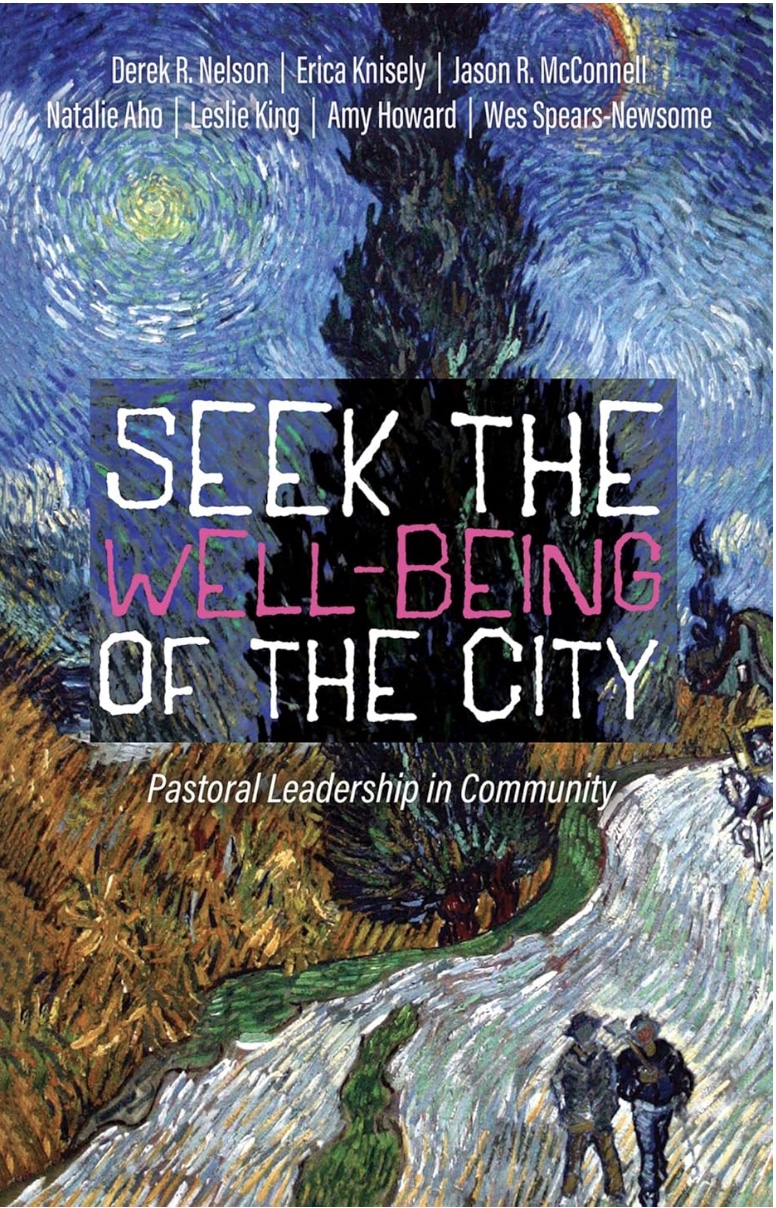
Seeking the Well-Being of the City: Pastoral Leadership in Community
Nelson, Derek R., Erica Knisely, Jason R. McConnell, Natalie Aho, and Leslie King.
Eugene, OR: Classic Books, 2025. 148pp. $21.00
Reviewed by Angie Ward, Director of the Doctor of Ministry and Associate Professor of Leadership and Ministry, Denver Seminary
Seek the Well-Being of the City was written during a five-day “book sprint” during which the authors sequestered themselves at Wabash College in Indiana to collaboratively put ideas to paper. The five authors have served as pastors and priests, professors, and denominational leaders. All also served as leaders or participants in the Early Career Leadership Development Initiative, a program initiated in 2008 by the Lilly Endowment. While the authors largely hail from mainline, Protestant backgrounds, they sought to represent all types of ministers and communities in their stories and examples.
“This book is a love letter to pastors, however you define that word,” the authors declare in the book’s introduction. True to the origins of this project, Seek the Well-Being of the City is written primarily to “early career” congregational leaders: those who have at least five years of ministry experience but have not yet entered their second decade, regardless of individual age.
Their main point? Effective pastoral ministry must take place in the context of community. The authors unpack this assertion over nine chapters distributed within three sections: Knowing in Community, Leading in Community, and Persisting in Community.
Foundational to the vision of “Knowing in Community” are clergy learning communities: cohorts characterized by common purpose, diversity, covenants, and shared experiences. This mirrors the emphasis on learning communities that is a hallmark of most Lilly-funded programs focused on congregational and clergy development.
While some clergy may be part of denominational or local networks, the authors of Seek the Well-Being of the City stress the importance of the diversity of participants across “racial and ethnic backgrounds, ecclesial traditions, genders, sexual orientations, socioeconomic status, and ministry settings” (23). Without this diversity, pastors can find themselves in echo chambers, ministering from tunnel vision. A shared goal and formal covenant can guide a learning community beyond mere meetings to a journey of shared formation. In the safety of these cohorts, clergy can develop their capacity for growth and explore their calling to be political leaders—defined as seeking peace, working for the good of the whole community, and using power in life-giving ways (45)—within their particular ministry context.
In “Leading in Community,” the authors turn their attention to lived pastoral leadership, starting with learning one’s (local) community, then discerning where and how to act, moving toward responding with one’s community, and finally to reflecting on one’s power. This process represents a common model of theological reflection, but applies the reflection loop to ministry and discernment in community, not simply to individual practice. Throughout this section, the authors provide practical approaches, activities, and questions to help readers build skills in these areas.
The final section of the book, “Persisting in Community,” focuses on the inevitable tensions that arise. Rather than depicting tension and resistance as unusual, the authors note that these are not only normal but even necessary components of congregational life, essential to change and growth. “Unless the pastor of the congregation injects tension into the system,” they write, “nothing will ever change and the church will slowly enter a coma or inactivity and eventually die.” Furthermore, the deepest pastoral joy can only be found in mutual engagement with congregation and community.
At only 148 pages, Seek the Well-Being of the City is an excellent introduction to the work of a pastor as congregational leader within a particular context. The systems perspective introduced in the chapter “Expecting and Managing Resilience” should be required reading for clergy of all ages and stages of ministry, to shape understanding and right-size expectations regarding the nature and necessity of tension in pastoral leadership.
While the title of the book focuses on the well-being of the city, that title might be a bit misleading, as pastoral contexts can range from urban to suburban to rural, and all points in between. The more important principles in this book rest in the subtitle, “Pastoral Leadership in Community.” Pastoral leadership is developed in community, applied in community both within and outside of the congregation, and supported in community with fellow clergy and with the congregation. In addition, while Seek the Well-Being of the City emerged from Lilly’s Early Career Leadership Development Initiative, the principles covered in this book can serve as both preparation for less-experience clergy, and as a needed reminder for clergy with more “mileage.” It can also be used as a springboard for discussion regarding the foundational nature of pastoral ministry, which varies in different theological traditions. Overall, it is a hopeful and practical book, worthy of inclusion in seminary preparatory courses and discussion within practitioner learning communities.