

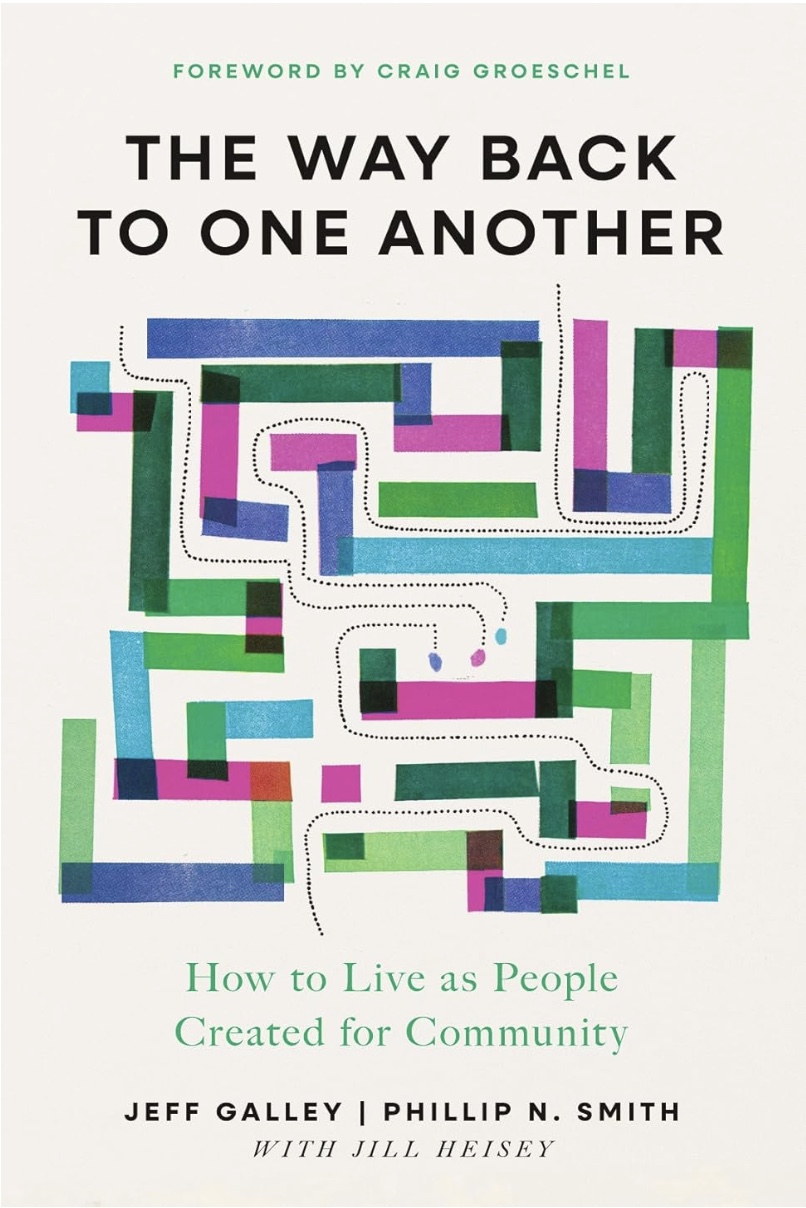
02 Mar 2026: The Way Back to One Another: How to Live as People Created for Community – Book Review
The Way Back to One Another: How to Live as People Created for Community
Jeff Galley and Phillip N. Smith with Jill Heisey
Downers Grove, IL: InterVarsity Press, 2026. 192 pp. $18.99
Reviewed by Andrew Yates, Advisor to Men and Coordinator for Global Discipleship at Dallas Theological Seminary
In the first few pages of the Bible, the Triune God identifies the first negative element in creation: humans being alone. In their forthcoming book, Galley and Smith argue convincingly that Western culture, including the Western church, has largely forgotten this problem and God’s solution to it. Written with more intellectual depth and personal vulnerability than one might expect from a popular-level book, this work is a must-read for individuals and community leaders concerned about perhaps the single most pressing issue in modern Western society: aloneness.
In The Way Back to One Another, Galley and Smith contend that while the entire world experiences rapid change, that change varies widely across individuals and cultures. Drawing on decades of leadership within large evangelical institutions and international ministries, the authors combine genuine sympathy for the Western experience with a desire to highlight the strengths of other cultural contexts. The result is an insightful and proven approach to addressing the increasing isolation crisis found in Western communities.
Viewing loneliness through a comparative cultural analysis, the authors help the reader grasp what may be a distinctly modern form of “aloneness.” Although “connected” in more ways, and to more people, than ever before, many Westerners remain isolated in deeply personal and meaningful ways. The elevation of “independence” which helped develop the entrepreneurial and pioneering Western world to its modern extreme has practically driven a population into isolation. The first chapters of The Way Back to One Another persuasively argue that the average American, including many church leaders, do not have a single a close friend and often lack any clear sense of how to develop authentic intimacy. This pattern of isolation, well documented in Western studies, stands in contrast to accounts of increasing relational depth typical of African and Asian contexts. Galley and Smith argue that this Western distinction is not simply a cultural norm by highlighting several ways this aloneness conflicts with biblical prescriptions of community and even human nature. Furthermore, the authors draw on recent scientific literature to demonstrate how an isolated worldview fuels a destructive and mutually reinforcing spiral of shame and further isolation.
Myself a Westerner, I was struck by how closely the patterns the authors describe mirrored the communities I serve and even my own experience. Thankfully, Galley and Smith give readers not only a mirror but a hopeful destination. Drawing on the testimony of Scripture and the lived experience of Christians in other parts of the world, a clear path is painted directing toward life-giving community. Using familiar language from influential authors such as Larry Crabb and Rick Warren (see Connecting: Healing for Ourselves and Our Relationships (1997) and The Purpose Driven Church (1995)), they emphasize the importance of the “one anothers” found in Scripture, all neatly grounded in Christ’s command to “love one another” (John 13:34–35).
Galley and Smith are quick to admit that while “loving one another” may not be a novel solution, a practical pursuit of this goal is increasingly radical. Five practical themes are given by which an individual and community can pursue loving others well: depending, knowing, talking, welcoming, and committing to one another. Each theme has a whole chapter devoted to it, illustrated with compelling stories demonstrating both growth and hope in authentic, loving communities. Each chapter also ends with well-crafted questions for personal reflection and communal discussion. The result is a book that is personally convicting and practically useful for both people and communities experiencing varying degrees of aloneness.
As the book progresses, some readers may find the many narratives of authentic Christian love slightly unsetting in their description. Much like a lived experience in community, not every story ends neatly, and several conclude in disappointing or even troubling places without commentary. Still, these accounts offer an honest picture of the real power, complexity, and cost of community. These stories reveal the tension between accountability and discipleship, inviting the reader to love others as they truly are, not as you would have them be. Readers in cultures shaped primarily by justice rather than honor–shame or power–fear frameworks, may struggle with these stories where the authors promote “unconditional acceptance.” Galley and Smith allow this discomfort, only in the final chapters providing a slight caveat to ensure wisdom and safety are not abandoned. In a similar vein, while the authors affirm Brené Brown’s sweeping critique of shame and judgment, they do not engage her more nuanced distinction between shame (judgment) and guilt (discernment) on the other. Brown argues that shame and judgment distort one’s sense of self, whereas guilt and discernment can play a healthy role in sustaining relationships (see Daring Greatly (2012). These gaps are relatively minor and likely reflect the limits of space in a book that aims to introduce a path forward rather than provide a comprehensive treatment.
In conclusion, this book is a timely and much-needed voice in an increasingly isolated Western context. Written with church leaders in mind, it includes a helpful appendix with practical steps for cultivating healthier, more relational local communities. Despite its modest length of 192 pages, the book is dense with insight and brings together many respected voices to address what is an existential threat to human flourishing. Serious Christian leaders and students alike would benefit from engaging its themes. Personally, this book challenged me to embody the love of Christ more intentionally in my own community, and I am grateful for Galley and Smith’s work. As one of the strongest contemporary treatments of Western isolation, it is a resource that should not be left alone.